Understanding Health Coverage for the Self-Employed (FIE) in Estonia
Navigating the administrative maze of becoming a sole proprietor, or FIE (Füüsilisest isikust ettevõtja), in Estonia often feels like a rite of passage for many expats. While the digital infrastructure is world-class, the specific requirements for securing state health insurance as a self-employed individual can be incredibly confusing and high-stakes. This guide breaks down exactly how to secure, pay for, and maintain your health coverage so you never face a medical emergency unprotected.
The Foundation of FIE Health Insurance in Estonia
When you decide to go the FIE route, you are essentially stepping into the roles of both employer and employee. This dual identity is most apparent when dealing with the Estonian Health Insurance Fund, now known as Tervisekassa. Unlike a traditional job where your HR department handles the paperwork and tax deductions, as an FIE, the responsibility for your health coverage rests squarely on your shoulders. It is a common frustration for newcomers to realize that simply having a residence permit or an ID card does not automatically grant you access to the public healthcare system.
What Does it Mean to be an FIE in the Healthcare System
In the eyes of the Estonian state, an FIE is a person who offers goods or services for a fee and is registered in the e-Business Register. From a healthcare perspective, this registration is the trigger that allows you to eventually access the same high-quality care as any salaried worker in Tallinn or Tartu. However, the system is contribution-based. You are not "buying" insurance in the way you might buy a policy from a private company; instead, you are paying into a social solidarity system.
The Tervisekassa operates on the principle that those who are fit to work and earn an income contribute to the pool, ensuring that everyone—including children and pensioners—has access to care. As an FIE, you must understand How Estonia's Health Insurance Fund (Tervisekassa) Works: A Full Overview to appreciate that your contributions are not just a personal fee, but a mandatory social tax that entitles you to a wide range of services.
The Role of the Tervisekassa for the Self-Employed
The Tervisekassa is the gatekeeper of public health services in Estonia. For the self-employed, it serves as the entity that validates your right to receive medical care, subsidized prescriptions, and sick leave benefits. Once you are correctly registered and your taxes are flowing, your status in the national database changes to "insured." This status is what doctors see when they look up your Isikukood (Personal Code) in the digital system.
It is important to manage your expectations early on. The Tervisekassa is highly efficient, but it is also rigid. If your tax payments are late or your registration has an error, the system will automatically flip your status to "uninsured," often without a warning phone call. This is why many expats choose to supplement their early days in the country with a flexible plan from SafetyWing, especially during the initial transition period when the state system hasn't fully kicked in yet.
Social Tax and the Financial Mechanics of Coverage
The most significant hurdle for any FIE is the social tax. In Estonia, health insurance is funded through a 33% social tax on your income. For a salaried employee, the employer pays this on top of the gross salary. For an FIE, you are responsible for calculating and paying this yourself. This often leads to "sticker shock" for those who aren't prepared for the total tax burden of self-employment in the Nordics.
Calculating Your Social Tax Contributions
The social tax isn't just a flat fee; it is calculated based on your business profits. However, the state sets a "minimum obligation." Even if your business makes zero profit in a given month, you are generally required to pay social tax based on a minimum monthly rate established by the state budget each year. For 2024 and 2025, this minimum base has been steadily increasing, meaning your baseline cost for health insurance is also rising.
If your profits exceed the minimum base, you will eventually owe 33% on that higher amount during your annual tax declaration. Understanding How Much Tax Does an FIE Pay in Estonia in 2026? is vital for your financial planning. You need to set aside roughly one-third of your net earnings just to cover this social obligation. If you fail to meet the minimum, you risk losing your health coverage entirely, which is a stressful situation no expat wants to face while trying to grow a business.
Advance Payments and Quarterly Deadlines
One of the unique aspects of being an FIE is the requirement to make "advance payments" of social tax. The Estonian Tax and Customs Board (MTA) expects you to pay these contributions four times a year: by the 15th of March, June, September, and December. These payments are essentially a down payment on your health insurance.
Many expats get caught out by these deadlines. If you miss a payment, the MTA will notify the Tervisekassa, and your insurance can be suspended. This is a very different experience from the "pay-as-you-go" monthly systems in other countries. To ensure you are staying compliant, you should regularly check Understanding Social Tax and Pension Contributions in Estonia to stay updated on the latest rates and payment procedures. It’s also wise to have a secondary option like SafetyWing in place for those moments when you might be traveling or between tax cycles and want to ensure continuous global coverage.
| Payment Period | Deadline | Requirement |
|---|---|---|
| Quarter 1 | March 15th | 1/4 of the annual minimum social tax obligation |
| Quarter 2 | June 15th | 1/4 of the annual minimum social tax obligation |
| Quarter 3 | September 15th | 1/4 of the annual minimum social tax obligation |
| Quarter 4 | December 15th | 1/4 of the annual minimum social tax obligation |
Navigating the Waiting Period and Eligibility
Perhaps the most frustrating part of the FIE journey is the "waiting period." Estonia does not grant immediate health insurance the moment you register as an FIE. There is a built-in delay designed to prevent people from registering only when they get sick. Understanding this gap is essential for your safety and peace of mind.
When Does Your Insurance Actually Kick In
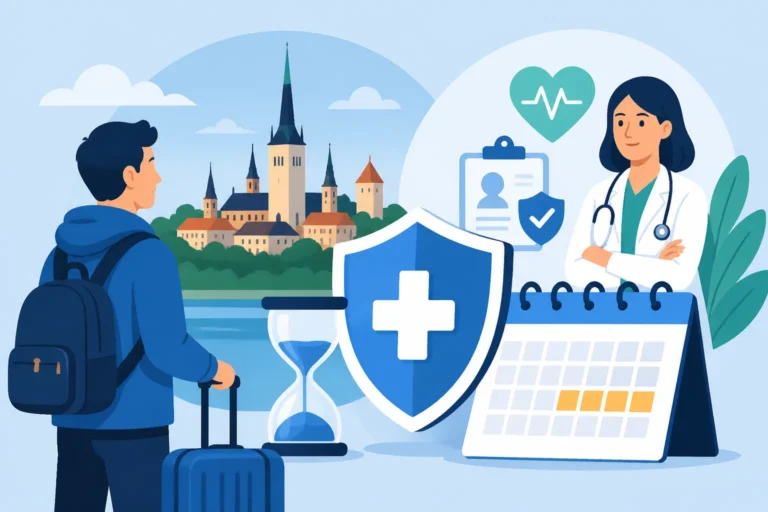
When you register as an FIE in the Business Register, the information is forwarded to the Tervisekassa. However, your coverage typically only begins 14 days after the entry is made, provided that the registration was done correctly and your intent to pay taxes is clear. If you are moving to Estonia and starting as an FIE immediately, you will have a minimum of two weeks where you have absolutely no state medical cover.
In some cases, if there are complications with your residency or tax status, this waiting period can feel even longer. Many veteran expats advise new arrivals to maintain their previous insurance or use a provider like SafetyWing to cover this 14-day (or longer) gap. There is nothing worse than arriving in Tallinn, catching a heavy winter flu, and realizing you aren't yet in the system. You can read more about this in Understanding Health Insurance Waiting Periods for New Residents in Estonia to see how to plan your move effectively.
The Importance of Your Isikukood in the Process
Everything in Estonia revolves around your 11-digit personal code, the Isikukood. Without it, you cannot register as an FIE, and without an FIE registration linked to your Isikukood, the Tervisekassa has no way to "find" you in the digital ecosystem. The process is a sequence: get your residence registered, get your Isikukood, register as an FIE, and then wait for the Tervisekassa status to update.
If you are a non-EU citizen, the process involves even more steps related to your residence permit. It is highly recommended to follow the steps in How to Get Your Isikukood (Personal Code) and Why It Matters for Healthcare as your very first priority upon arrival. Until that number is active and linked to your self-employment, you are effectively a ghost in the healthcare system.
Practical Steps to Register and Manage Coverage
Once you have your Isikukood and have decided to take the leap into self-employment, the actual "doing" part happens online. Estonia’s e-government services are excellent, but they require a certain level of digital literacy and the right tools, like an ID card or Smart-ID.
Registering with the Tax and Customs Board (e-MTA)
Your primary interface for health insurance as an FIE is not actually the Tervisekassa website, but the e-MTA (Tax and Customs Board) portal. This is where you declare your income and where the 33% social tax is recorded. When you register as an FIE in the e-Business Register, the MTA is automatically notified. However, it is your job to log into the e-MTA portal and ensure your contact details are correct.
The system is designed to be "set and forget" once you have your quarterly payments automated, but for the first year, you should be proactive. Check your "Insurance" status on the e-MTA Online Tax Portal in Estonia at least once a month. If you see any red flags or notices about missing social tax, address them immediately. The digital system is fast, but it is also unforgiving regarding deadlines.
Finding a Family Doctor (Perearst)
Having insurance is one thing; actually seeing a doctor is another. In Estonia, the "Perearst" (Family Doctor) is the cornerstone of the medical system. Even as a self-employed FIE with valid Tervisekassa insurance, you are not automatically assigned a doctor. You must find a doctor who has room on their practice list and submit a formal application.
This can be a challenge in cities like Tallinn or Tartu, where many practices are full. As an expat, you likely want an English-speaking doctor. For detailed advice on how to navigate this, check The Expat Guide to Finding a Family Doctor (Perearst) in Estonia. Don't wait until you are ill to do this. The registration process for a Perearst can take several days or even weeks to process, and they are your only gateway to specialist care through the public system.
Bridging the Gap: Private Insurance for the Self-Employed
While the Estonian public system is excellent once you are in, the reality of being self-employed is that your income—and therefore your tax status—can fluctuate. There are also things the state system doesn't cover well, such as medical evacuation, private hospital rooms, or coverage when you are working remotely from outside Estonia.
Why Consider SafetyWing for Your FIE Journey
This is where a provider like SafetyWing becomes a valuable asset for the modern nomad or expat FIE. SafetyWing offers a bridge between the rigid state requirements and the reality of a global lifestyle. If you are an FIE who frequently travels back to your home country or spends winters in warmer climates, Tervisekassa might not provide the level of international protection you need.
SafetyWing is specifically designed for people who don't fit the traditional 9-to-5 mold. It can act as your primary insurance during the 14-day Tervisekassa waiting period, or as a continuous supplement to handle emergencies that fall outside the scope of Estonian public clinics. Because it operates on a subscription basis, it aligns perfectly with the fluctuating nature of self-employment income. Having that extra layer of security means that even if you have a dispute with the Tax Board over a social tax payment, you aren't left entirely exposed.
Dealing with Gaps in State Coverage
Gaps in coverage can happen for various reasons: you might stop being an FIE to take a short-term contract abroad, or you might fail to meet the minimum income requirement during a slow business year. In these instances, your Tervisekassa coverage will end. Unlike employees who get a two-month "grace period" after their contract ends, FIEs generally lose coverage much faster once their status changes or payments stop.
For those navigating these transitions, understanding Health Insurance in Estonia: Mandatory, Private and Travel Options Explained is vital. You should always have a "Plan B." Whether it's moving to voluntary insurance with the Tervisekassa (which is expensive) or maintaining a private policy, being uninsured in Estonia is a significant risk. Private options like SafetyWing provide that much-needed "safety net" that allows you to focus on your business rather than worrying about the cost of an unexpected hospital stay.
Benefits and What’s Covered for FIEs
If you’ve done everything correctly—paid your social tax, waited out the 14 days, and registered with a Perearst—you now have access to one of the most efficient healthcare systems in Europe. As an FIE, you are entitled to almost all the same benefits as a regular employee.
Standard Medical Services and Prescriptions
Your Tervisekassa coverage includes visits to your family doctor, specialist consultations (usually requiring a referral), hospital stays, and emergency care. One of the best features of the Estonian system is the Digiretsept (Digital Prescription) System in Estonia. Once your doctor issues a prescription, it is linked to your Isikukood. You simply go to any pharmacy (Apteek), show your ID card, and they can see exactly what you need.
The state also subsidizes many medications. For chronic conditions, this can save you hundreds of euros a month. As an FIE, you are paying into this system, so you should absolutely take advantage of these subsidies. You can track all your medical history, prescriptions, and test results through the Digilugu (Digital Health Record) System in Estonia, which is an incredible tool for staying on top of your personal health.
Sick Leave and Social Benefits
A common misconception is that FIEs don't get sick pay. In reality, because you pay social tax, you are entitled to sickness benefits. However, the rules are slightly different than for employees. Typically, the first few days of illness are not compensated, and the Tervisekassa starts paying from the second or fourth day depending on the current legislation.
To receive these benefits, your doctor must open a "certificate for care" or a "sick leave certificate" in the digital system. This is a crucial step; if the doctor doesn't log it digitally, the Tervisekassa won't know you are unable to work. For a deep dive into how this works for the self-employed, see Understanding Sick Leave (Haigusleht) and Sick Pay in Estonia. Managing your own sick leave is part of the administrative burden of being an FIE, but it’s a financial lifesaver if you ever face a long-term health issue that prevents you from running your business.
Disclaimer
The information provided in this guide is for informational purposes only and does not constitute legal, financial, or medical advice. Estonian tax laws and healthcare regulations, including social tax rates and Tervisekassa eligibility rules, are subject to change. Always consult with the Estonian Tax and Customs Board (MTA), the Health Insurance Fund (Tervisekassa), or a qualified professional accountant to ensure your specific situation is compliant with current 2026 regulations. While private options like SafetyWing are mentioned as potential supplements, readers should evaluate all insurance policies independently to ensure they meet their specific needs and residency requirements.