Understanding Health Insurance Through Social Tax in Estonia
Moving to a new country often involves a steep learning curve, and in Estonia, one of the most confusing hurdles for expats is the healthcare system. You might hear people talk about "free" healthcare, only to realize it is tied to a complex tax structure called social tax. This guide provides a deep dive into how social tax functions as the engine of the Estonian medical system, helping you understand your rights, your coverage timelines, and how to avoid the common trap of being uninsured during your first weeks in the country.
The Foundation: What Exactly is Social Tax (Sotsiaalmaks)?
When you look at your first Estonian payslip, you might be surprised to see a significant percentage attributed to something called sotsiaalmaks. Unlike income tax, which is often shared or calculated based on your personal allowance, social tax is a massive 33% levy on your gross salary. However, it is important to realize that in a standard employment relationship, this is an additional cost paid by your employer, not a deduction from your advertised gross wage. This distinction is vital for your financial planning and for understanding your value to a local company.
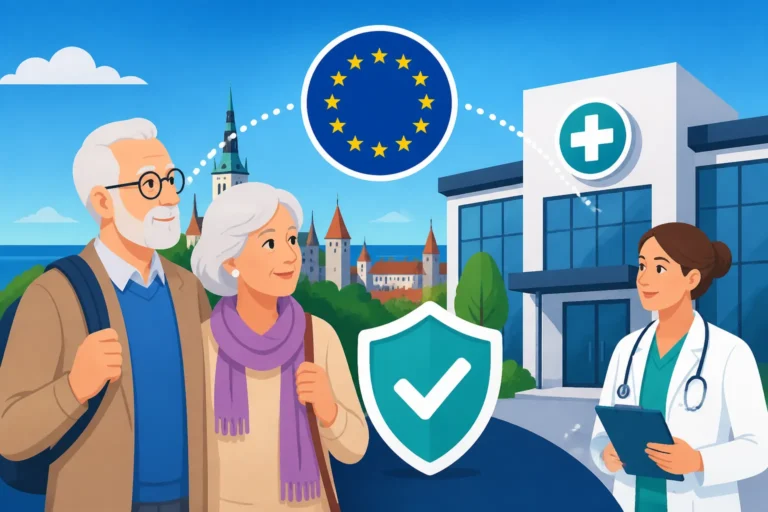
This 33% is not a monolithic fund. It is strictly divided by the state to provide two major pillars of social security. First, 20% is directed toward the state pension insurance fund, ensuring that the working population supports current retirees and builds a future safety net. The remaining 13% is what we are focusing on today: the health insurance component. This 13% goes directly to the How Estonia's Health Insurance Fund (Tervisekassa) Works: A Full Overview to provide you with comprehensive medical coverage. It is a solidarity-based system, meaning your level of care is not determined by how much tax you pay; a CEO and a junior developer receive the same high standard of treatment.
For many foreigners, the idea of a solidarity system can feel alien, especially if you come from a country with tiered private insurance. In Estonia, the social tax ensures that as long as you are contributing to the economy, you have a seat at the table. However, this also means that if the contributions stop—perhaps due to a gap in employment or a failure to register a business correctly—the coverage can disappear surprisingly fast. This is why veteran expats often stress the importance of understanding the Understanding Social Tax and Pension Contributions in Estonia before you sign your first contract.
The Employer’s Role in Your Coverage
Your employer is the primary gatekeeper of your health insurance. The moment you sign an employment contract, the company is legally obligated to register you in the Employment Register (Töötamise register). This register is managed by the Tax and Customs Board and is digitally linked to the healthcare system. You don't actually have to visit a physical office to "sign up" for insurance in the traditional sense; the digital handshake between your employer's tax declaration and the health fund does the work for you.
However, bureaucracy—even the world-class digital bureaucracy of Estonia—takes time. I remember the anxiety of my first week in Tallinn, wondering if I could see a doctor if I tripped on the cobblestones of Old Town. The reality is that your insurance usually kicks in after a specific waiting period, which we will detail later. If your employer forgets to register you or enters your How to Get Your Isikukood (Personal Code) and Why It Matters for Healthcare incorrectly, the link breaks. It is always wise to log into the state portal to verify that your status is "insured."
The Solidarity Principle vs. Individual Costs
The beauty of the social tax system is that it covers almost everything from routine check-ups to life-saving surgeries. Because the 13% health component is pooled, the system can afford to offer high-tech treatments that would otherwise be unaffordable for the average worker. But there is a catch: the system is designed for residents. If you are a digital nomad or waiting for your residency permit to be processed, you aren't paying into this pool yet.
During these transition periods, many expats rely on flexible alternatives. For instance, a plan from SafetyWing can be a lifesaver when you are physically in Estonia but haven't yet triggered the social tax threshold. It fills the gap between your arrival and the moment your Estonian insurance officially "wakes up." Once you are fully integrated and paying social tax, you transition into the public system, but having that initial bridge is a common strategy for seasoned travelers.
How Your Coverage is Activated: The Registration Process
Activation is not instantaneous. This is the part that catches most newcomers off guard. Under Estonian law, health insurance coverage through employment begins after a 14-day waiting period from the entry made in the Employment Register. If you start work on the 1st of the month, your Tervisekassa coverage typically becomes active on the 15th. This 14-day window is a "dead zone" where you are legally working but not yet covered by the state medical fund.
This is a critical period where you must be careful. If you have a pre-existing condition or if an accident happens on day five of your new job, the state will not pick up the tab. This is another scenario where having supplemental coverage like SafetyWing is highly recommended. It ensures that you aren't gambling with your health during those first two weeks of your new Estonian life. Once those 14 days pass, the system updates automatically, and you can see this status reflected on the Navigating Estonia's Digital Healthcare System: An Expat's Roadmap (2027).
Verifying Your Status on the State Portal
Estonia’s digital society means you rarely need to carry a physical insurance card. Your national ID card serves as your proof of insurance. However, you should proactively check your status on the eesti.ee portal. Once you log in with your Smart-ID or ID card, look for the "Health Insurance" section. It will explicitly state whether your insurance is "active," the "basis" of the insurance (usually "employed person"), and the "end date" (which is usually blank if you have a permanent contract).
If you see that your status is inactive despite having worked for over two weeks, your first call should be to your HR department. Sometimes there is a lag in the tax board's data sync, or perhaps your How to Register with the Tervisekassa as a Foreigner in Estonia process hit a snag because of a typo in your personal code. Don't wait until you are sick to fix this; the Estonian system is efficient, but it requires accurate data to function.
The "Bridge" Coverage for New Residents
For those moving to Estonia from outside the EU, there is often a longer gap. You might arrive on a D-visa, find an apartment, and then spend a month interviewing for jobs. During this time, you are not paying social tax, and therefore, you have no access to the Tervisekassa. You are essentially a long-term tourist in the eyes of the healthcare system.
It is a common mistake to think that the visa requirement for "insurance" is just a formality. In reality, medical costs in Estonia for the uninsured are quite high. A single emergency room visit can cost several hundred euros, and a hospital stay can run into the thousands. Maintaining a global policy, such as SafetyWing, during this job-hunting phase is not just about satisfying visa requirements; it’s about protecting your savings while you wait to join the social tax pool.
The Financial Mechanics: Breakdown of the 33% Social Tax
To truly understand how your healthcare is funded, we need to look at the numbers. The 33% social tax is calculated based on your gross salary. If your gross salary is €2,000, your employer actually pays €2,660 total (€2,000 to you/taxes and €660 in social tax). Out of that €660, approximately €260 is earmarked specifically for your healthcare. This happens every single month.
| Feature | Social Tax Insurance (Tervisekassa) | Private/Nomad Insurance (e.g., SafetyWing) |
|---|---|---|
| Funding Source | 13% of Gross Salary (Paid by Employer) | Individual Monthly Premium |
| Activation Time | 14 days after employment start | Immediate or scheduled |
| Primary Doctor | Required to register with a Perearst | Usually allows any private clinic |
| Hospital Stays | Covered (with small daily fee) | Covered up to policy limits |
| Prescriptions | Subsidized via Digiretsept | Reimbursement based on policy |
| Geographic Scope | Estonia (EU with EHIC card) | Global / Multiple Countries |
| Best For | Long-term residents & employees | New arrivals, nomads, and gap periods |
Minimum Social Tax Obligations
Estonia has a "minimum social tax" rule to prevent people from working one hour a month just to get "free" healthcare. Every year, the state sets a minimum base for social tax. If you work part-time and your salary is below this base, your employer must still pay the social tax based on the minimum monthly rate (unless you fall under specific exceptions like being a student or a pensioner). For 2024 and 2025, this base has been steadily rising.
This is particularly relevant if you are negotiating a freelance contract or a very small part-time role. If the employer isn't willing to pay the minimum social tax base, you will not be insured. This is a common trap for expats who take on multiple small gigs instead of one steady job. Always ensure that at least one of your employers is paying the social tax at the required minimum level to keep your Health Insurance in Estonia: Mandatory, Private and Travel Options Explained status active.
Healthcare vs. Pension Components
It is worth noting that while your 13% provides immediate healthcare, the 20% pension component is a long-term play. If you leave Estonia after a few years, that pension contribution remains in the Estonian system (though there are ways to claim it later depending on your home country's social security agreements). The healthcare portion, however, is consumed "as you go." You are paying for the right to use the system today. This is why the system feels so robust; it is constantly being replenished by the active workforce.
Navigating the System as an Employee vs. Freelancer (FIE)
If you are a standard employee, your life is simple: the employer handles everything. You just show up, work, and your insurance is active. But many expats choose the path of the FIE (Sole Proprietor) or start their own OÜ (Private Limited Company). If you are an FIE, the burden of social tax falls entirely on your shoulders. You must pay social tax on your business profits, and there are quarterly mandatory payments you must make to maintain your insurance.
For many FIEs, the quarterly payments can be a shock. You are effectively paying both the employer and employee "sides" of the social security coin. If you miss a payment or if your business has a bad quarter where you don't meet the minimum social tax base, your health insurance will be suspended. Many freelancers find this stress too much to handle and opt for a private policy like SafetyWing as a backup, or they ensure they have a healthy cash reserve specifically for the Tax Board. You can learn more about this in our guide on Understanding Health Coverage for the Self-Employed (FIE) in Estonia.
The OÜ Route: Being Your Own Employer
If you run an OÜ, you have a bit more flexibility, but it requires careful accounting. You can pay yourself a "board member's fee" or a "salary." To get health insurance, you must pay yourself a salary or fee that meets the minimum social tax threshold. If you only take dividends from your company, you pay 20% income tax but 0% social tax—which means you have no state health insurance.
Many expats start a company, take only dividends to save on taxes, and then realize they have no coverage when they get the flu. It is a balancing act. You have to decide if the tax savings are worth the cost of buying a separate private insurance policy. Most people who live here long-term find that paying the minimum salary to trigger the Tervisekassa coverage is the most efficient way to handle things, as it also provides access to the Understanding Sick Leave (Haigusleht) and Sick Pay in Estonia system.
Transitioning Between Employment Types
What happens if you quit your job to become a freelancer? There is a grace period. Usually, your insurance continues for two months after your employment ends. This is a generous safety net that gives you time to register as an FIE, start your own company, or find a new job. However, the moment that two-month window closes, you are "dark" in the system.
During these transitions, the risk is high. If your new business hasn't started generating enough revenue to cover the social tax base, you are essentially uninsured. This is the perfect time to activate a flexible, month-to-month policy like SafetyWing. It gives you the breathing room to build your business without the constant fear that a single medical emergency will bankrupt your new venture.
What Does Social Tax Coverage Actually Get You?
Once your social tax is flowing and your status is active, you have access to a world-class medical infrastructure. The cornerstone of this is the Perearst (Family Doctor). Under the social tax system, visits to your family doctor are free. This doctor is your gateway to everything else. If you need to see a cardiologist or a dermatologist, your Perearst will issue a How E-Referrals (Saatekiri) Work for Specialists in Estonia.
Without this referral, you can still see a specialist, but you will have to pay the full private price out of pocket. This is one of the most common frustrations for expats who are used to just calling up a specialist directly. In Estonia, the social tax system relies on the Family Doctor to act as a "triage" to keep the specialist waiting lists manageable. To get started, you should check out The Expat Guide to Finding a Family Doctor (Perearst) in Estonia.
Specialist Care and Hospital Stays
When you have a referral, the cost of seeing a specialist in a public hospital is capped at a very small "visit fee" (usually around €5). If you are hospitalized, the social tax covers your surgery, your medication, and your stay. You might be charged a nominal daily "bed fee" (around €2.50 per day for up to 10 days), but compared to the thousands of euros it actually costs to run a hospital, this is essentially free.
The quality of care in Estonian hospitals like Regionaalhaigla in Tallinn or the University Clinic in Tartu is exceptional. However, wait times can be long for non-urgent issues. Because the system is "free" via social tax, demand is high. If you are covered by social tax but don't want to wait three months for a routine specialist appointment, you can always choose to go to a private clinic and pay the full price. Many expats do a mix of both.
The Digital Advantage: Prescriptions and Dental
One of the coolest features of the Estonian system is the Understanding the Digiretsept (Digital Prescription) System in Estonia. When your doctor prescribes medication, they enter it into the system digitally. You simply walk into any pharmacy, show your ID card, and they see your prescription. Because of your social tax contributions, many medications are heavily subsidized—sometimes up to 50%, 75%, or even 100% depending on the severity of the condition.
Dental care is a bit different. For adults, social tax insurance provides a very limited annual benefit (usually around €60, though this changes periodically). For most dental work, you will be paying out of pocket. This is one area where the "free" healthcare claim falls short for adults, and it is something to budget for separately. For children under 18, however, dental care is completely covered by the health insurance fund, provided the dentist has a contract with the Tervisekassa.
Common Pitfalls and Gaps in Social Tax Insurance
The biggest pitfall is the assumption that "employed" always equals "insured." As mentioned earlier, there are minimum salary requirements. If you are on a zero-hour contract or working for a startup that is struggling to make its tax payments, your insurance could be at risk. The state is very strict: if the social tax isn't paid, the insurance isn't active.
Another common issue is the gap between jobs. While the two-month grace period is helpful, it only applies if you worked for a certain duration previously. If you had a very short contract (less than a month) and it ended, your grace period might be significantly shorter or non-existent. Always double-check your status on eesti.ee the day after a contract ends.
Understanding the Geographic Limits
Your Estonian social tax insurance is great while you are in Estonia. If you travel within the EU, you can use your European Health Insurance Card (EHIC) for emergency care. However, the EHIC is not a replacement for travel insurance; it only covers what a local would get for free, and it doesn't cover things like medical repatriation or private clinic costs.
If you are traveling outside the EU—say, a trip to the US, Asia, or even the UK—your Estonian social tax insurance provides zero coverage. This is a major gap. Even if you are a loyal taxpayer in Tallinn, you are on your own the moment you leave the Schengen zone. This is why many expats keep a global policy like SafetyWing active for their travels. It complements your local social tax coverage by providing global protection that the Tervisekassa simply cannot offer.
Sick Leave and Social Tax
Finally, your social tax is what funds your Haigusleht (Sick Leave). In Estonia, if you are too sick to work, your doctor opens a digital sick leave certificate. For the first few days, you might not get paid, but from day four onwards, the Tervisekassa (and partially your employer) pays you a percentage of your average salary. This ensures that a bout of the flu doesn't result in a total loss of income. You can find a full breakdown of this in Understanding Sick Leave (Haigusleht) and Sick Pay in Estonia.
Without being in the social tax system, you have no access to this benefit. If you are a freelancer without social tax coverage and you get sick, you simply don't earn money. This "hidden" benefit of the social tax system is often what makes it worth the 13% for many self-employed expats. It’s not just about the doctor’s visit; it’s about income protection.
Disclaimer
The information provided in this guide is for informational purposes only and does not constitute legal, financial, or medical advice. Tax laws and healthcare regulations in Estonia are subject to change. Always consult with the Estonian Tax and Customs Board (MTA), the Health Insurance Fund (Tervisekassa), or a qualified legal professional to confirm your specific situation and obligations.