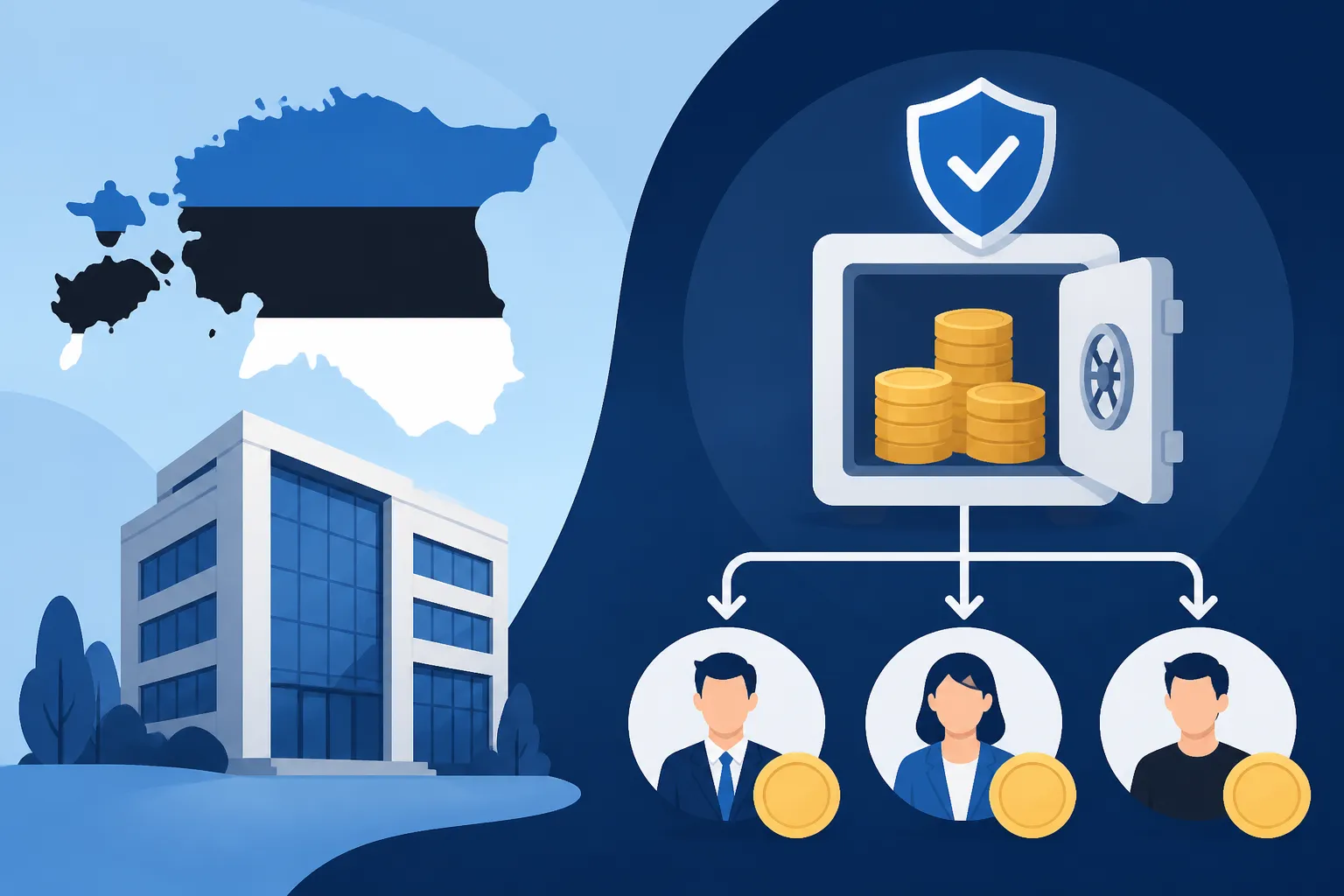
Understanding Estonia’s Corporate Tax System: Tax Only on Distributed Profit (2027)
One of the biggest head-scratchers for new arrivals, especially those looking to set up a business or freelance in Estonia, is navigating the local tax system. It’s certainly not like what many of us are used to back home. You might hear whispers about "zero corporate income tax" and think it's too good to be true, or perhaps just a myth. Well, it's not a myth, but it's also not entirely zero in the way most people imagine. This guide is here to untangle the unique beast that is Estonia's corporate tax system, focusing specifically on the principle of taxing only distributed profits, so you can approach your business ventures here with clarity and confidence.
The Core Principle: Tax Only on Distributed Profit
Estonia stands out globally for its innovative approach to corporate taxation, a system that many find revolutionary but equally perplexing if you're not familiar with it. At its heart lies a deceptively simple idea: companies only pay corporate income tax (CIT) on profits they actually distribute, not on profits they retain or reinvest within the company. This means that as long as your company's profits stay within the business – perhaps accumulating in a bank account, being used for investments, or covering operational costs – they remain untaxed at the corporate level. It's a fundamental shift from the traditional model seen in most countries, where annual profits are taxed regardless of what the company chooses to do with them.
What Does "Distributed Profit" Actually Mean?
So, if retained earnings aren't taxed, what exactly triggers the tax event? In Estonia, "distributed profit" primarily refers to dividends paid out to shareholders. When a company decides to take a portion of its accumulated profits and distribute them to its owners, that's the moment the corporate income tax liability arises. It’s not an annual assessment based on your profit and loss statement; it’s an event-based tax, triggered by the actual act of moving money out of the company to its shareholders. This also extends to other forms of profit distribution, such as fringe benefits, gifts, donations, entertainment expenses, and even certain costs not related to business operations. The tax authorities are quite keen on ensuring that disguised profit distributions don't slip through the cracks without being taxed, so it's vital to classify your expenses correctly and understand what constitutes a taxable distribution.
For example, imagine your Estonian OÜ (private limited company) earns €100,000 in profit over a year. If you decide to keep all that money within the company to fund a new project, purchase equipment, or simply save for a rainy day, the company owes €0 in corporate income tax. However, if you decide to pay out €50,000 of that as dividends to yourself (as the shareholder), then that €50,000 becomes taxable at the corporate level. This approach encourages companies to reinvest their earnings, fostering growth and economic development, which was precisely the intention behind its introduction back in 2000. It effectively allows businesses to grow tax-free until they decide to cash out.
Historical Context and Why Estonia Adopted This System
Estonia introduced this unique corporate tax system in the year 2000, driven by a desire to stimulate economic growth and attract foreign investment in the post-Soviet era. The country's leaders envisioned a dynamic, entrepreneurial economy, and they recognized that traditional corporate tax structures could be a barrier to this. By removing the tax burden on reinvested profits, the aim was to encourage businesses, both domestic and international, to keep their earnings within Estonia, fueling further expansion, innovation, and job creation. The thinking was, if companies could grow faster without immediate tax penalties, the overall economy would benefit, leading to higher wages, more employment, and eventually, more personal income tax revenue and consumption taxes (like VAT).
The system was also designed to simplify tax administration. Instead of complex calculations involving depreciation, various deductions, and capital allowances that many other countries grapple with annually, the Estonian system shifts the focus to the point of distribution. This significantly reduces the administrative burden for companies and streamlines the tax declaration process. For many expats, especially those used to quarterly or annual corporate tax filings, this simplicity can be a breath of fresh air, though it still requires meticulous record-keeping. The broader goal was to create a competitive and attractive business environment, especially for small and medium-sized enterprises (SMEs) and startups, allowing them to scale up rapidly using their own retained capital. This vision has largely paid off, contributing to Estonia's reputation as a digital and business-friendly nation.
How It Differs from Traditional Corporate Tax Systems
For many of us who grew up with traditional tax regimes, the Estonian system feels like an inversion of everything we've learned. In most countries, corporate income tax is an annual affair, levied on the company's taxable profits (revenue minus allowable expenses) regardless of whether those profits are retained, reinvested, or distributed. You close your financial year, tally up your profits, apply any deductions, and then pay a percentage of that figure to the government. This often means that even if a company is pouring all its earnings back into research and development, expanding operations, or buying new assets, it still has to cough up a significant portion in corporate tax first.
Estonia's system flips this on its head. It’s not about earning profit; it’s about using profit. The tax obligation doesn't arise from your company's success in generating income, but from the specific decision to remove that income from the corporate entity. This distinction is crucial for understanding the financial planning and cash flow implications for your business in Estonia. It’s a powerful incentive for growth-oriented companies because it allows them to compound their earnings within the company without immediate tax erosion. This means more capital available for investment, expansion, or weathering economic downturns, directly benefiting the company's long-term health and potential.
Retained vs. Distributed Earnings: A Key Distinction
The difference between retained and distributed earnings is the bedrock of Estonia's corporate tax policy. When your company generates profit and chooses to retain those earnings, they remain within the company's assets, boosting its equity. This could be in the form of cash, new equipment, intellectual property development, or even simply a larger bank balance for future opportunities. These retained earnings are completely free from corporate income tax. This means that every euro of profit you make can be fully put back to work for your business, driving further growth without the state taking a cut.
However, when you decide to distribute those earnings – typically as dividends to shareholders – they become taxable. This distribution could be a regular payout, a one-off bonus, or even a deemed distribution if funds are used for non-business purposes that primarily benefit the owners. The tax is applied at the corporate level before the money reaches the shareholders. This distinction is vital for financial planning. Companies need to strategically decide how much profit to retain for reinvestment versus how much to distribute for personal income, keeping in mind the subsequent personal income tax implications that shareholders will face. It’s not just about the corporate tax, but the entire lifecycle of the profit from earning to personal consumption.
Implications for Business Growth and Reinvestment
The implications for business growth and reinvestment under this system are profound and form a major draw for entrepreneurs and foreign investors. Because retained profits are not taxed, companies have a much stronger incentive to reinvest every cent of their earnings back into the business. This creates a powerful engine for self-funded growth. Imagine a startup that is trying to rapidly scale, innovate, and capture market share. In a traditional tax environment, a significant portion of their hard-earned profits would be siphoned off in corporate tax, leaving less capital for R&D, hiring new talent, or expanding infrastructure.
In Estonia, that startup can channel 100% of its profits back into operations, accelerating its growth trajectory. This policy directly encourages capital accumulation within businesses, allowing them to fund ambitious projects, invest in cutting-edge technology, or expand into new markets without needing to seek as much external financing. This focus on reinvestment fosters a dynamic and entrepreneurial ecosystem, which is particularly attractive to tech companies and startups. It means your company can become larger, stronger, and more resilient much faster than it might in a country with a traditional upfront corporate tax burden, making Estonia a very appealing place to establish and grow a business.
Practical Application for Estonian Companies (OÜs)
For many expats, setting up an OÜ (Osaühing or private limited company) is the most common way to do business in Estonia, whether you're a freelancer, a consultant, or running a full-fledged startup. Understanding how the distributed profit system applies specifically to your OÜ is crucial. It means your annual financial statements, while important for showing profitability and financial health, don't automatically trigger a corporate tax bill. The tax liability only materializes when a decision is made to take money out of the company for the benefit of its owners, typically through dividends.
This leads to a distinct approach to financial management. You're not worrying about minimizing your "taxable profit" at the end of the year through complex accounting manoeuvres. Instead, your focus shifts to managing your cash flow and making strategic decisions about when and how much profit to distribute. This flexibility allows companies to optimize their tax payments in line with their business cycle and personal financial needs. For instance, if you're in a growth phase, you might choose to retain all profits for several years, deferring corporate tax indefinitely. When you're ready to take out profits, you simply declare the distribution, and the tax is calculated and paid at that point. It's an active decision, not a passive consequence of making money.
When and How Corporate Tax is Actually Paid
The moment a company decides to distribute profits, that's when the clock starts ticking for corporate income tax. This usually happens after the company's annual financial report is approved by the shareholders, who then make a formal resolution to pay out dividends. Once that decision is made, the company has an obligation to declare and pay the corporate income tax on those distributed amounts to the Estonian Tax and Customs Board (Maksu- ja Tolliamet). The declaration is typically made via form TSD (Declaration of Income Tax, Social Tax, Unemployment Insurance Premiums, and Contributions to the Mandatory Accumulating Pension) by the 10th day of the following month after the distribution decision. The payment must also be made by the same deadline.
For example, if your OÜ shareholders decide in June 2026 to pay out €20,000 in dividends, you would declare this distribution in your July TSD filing, and the tax payment would be due by July 10th. This means that unlike many other countries where corporate tax is paid annually on profits earned, in Estonia, the tax payment is directly tied to the specific event of profit distribution. This direct link makes the tax system transparent and gives businesses greater control over their tax outflow. It's a proactive rather than reactive system, demanding careful planning for cash flow, both for the company and for the personal finances of its owners.
Tax Rates on Distributed Profits
Estonia's corporate income tax rate on distributed profits is typically 20%. However, this rate is applied to the net amount of distributed profit, meaning the dividend after the tax has been theoretically deducted. To make it easier to compare with other countries' gross tax rates, it's often quoted as 20/80, which translates to a 25% tax on the gross amount of the distribution. So, if you decide to distribute €100,000, the tax would be calculated as 20% of €80,000 (the amount remaining after tax), which is €20,000. This leaves €80,000 for the shareholders. Or, viewed from the gross perspective, €20,000 is 25% of €80,000. It's a bit of a mathematical quirk that can initially confuse expats, but the effective burden is the same.
There's also a lower corporate income tax rate available under certain conditions, primarily for regular dividend distributions. If a company distributes dividends regularly over a three-year period, it can be eligible for a reduced rate of 14% (applied as 14/86 on the net amount, or roughly 16.28% on the gross amount). This reduced rate is intended to incentivize consistent dividend payouts rather than hoarding profits indefinitely. However, it’s important to note that if dividends are paid out at this lower 14% rate, an additional 7% personal income tax is withheld from the individual shareholder's dividend, making the total tax burden almost identical to the standard 20% corporate tax if the recipient is an individual. This nuance is crucial for expat entrepreneurs to understand, as it affects both corporate and personal tax planning.
| Type of Profit Distribution | Corporate Income Tax Rate (Gross) | Notes |
|---|---|---|
| Standard Dividend | 20/80 (effective 25%) | Applied to distributed amount. |
| Regular Dividend (reduced) | 14/86 (effective ~16.28%) | For consistent payouts over 3 years. Additional 7% withheld at personal level. |
| Fringe Benefits | 20/80 (effective 25%) | Subject to social tax and unemployment insurance on top. |
| Gifts, Donations, Non-business Expenses | 20/80 (effective 25%) |
Note: The actual calculation of tax on fringe benefits involves a complex formula including social tax and unemployment insurance, which adds significantly to the cost.
Benefits and Challenges for Expats and Foreign Investors
For many foreign investors and expats, Estonia's corporate tax system is a significant pull factor. The sheer flexibility and incentive for reinvestment can make it incredibly attractive, especially for those looking to start or scale a business. You're not immediately penalised for making a profit, which means more of your hard-earned cash can stay within the company to fuel its growth. This can lead to faster expansion, greater resilience, and ultimately, a more valuable business over time. It aligns perfectly with a growth-first mindset, which is prevalent in the startup and tech sectors.
However, like any system, it's not without its nuances and potential challenges, particularly for those unfamiliar with its intricacies. It requires a different way of thinking about business finance and personal income. Expats often come from countries where corporate and personal taxes are distinct and perhaps less intertwined at the point of distribution. Here, the decisions you make at the corporate level about profit distribution directly impact your personal tax situation, necessitating a holistic view of your financial planning. Understanding these benefits and potential pitfalls is key to successfully leveraging the Estonian system to your advantage.
Attracting Foreign Investment and Entrepreneurship
The "tax only on distributed profit" model has undeniably been a magnet for foreign investment and entrepreneurship. It creates an environment where companies, particularly startups and those in high-growth industries, can retain 100% of their profits for reinvestment. This means more capital for research and development, hiring talent, expanding infrastructure, or venturing into new markets. For a startup, every euro saved from immediate taxation can be crucial for survival and scaling. This policy helps to explain why Estonia has become such a hotbed for innovation and why initiatives like e-Residency have thrived, drawing entrepreneurs from around the globe to establish their businesses here.
For foreign investors, the system offers clarity and control. They know that as long as profits are kept within the Estonian company, there’s no corporate tax liability. This deferral of tax allows for greater capital efficiency and potentially higher returns on investment, as the full profit can continue to generate more profit. It also simplifies cross-border investment structures, as investors can decide when and how to extract profits, aligning with their broader international tax planning strategies. This transparent and growth-friendly approach has cemented Estonia's reputation as one of the most attractive places in Europe for starting and scaling a business. You might be considering The Complete Guide to e-Residency and Relocating to Estonia (2027) to see how this fits your plans.
Potential Pitfalls and Misconceptions for Newcomers
Despite its advantages, the Estonian corporate tax system can present pitfalls and misconceptions for newcomers, especially those accustomed to different tax regimes. One common misunderstanding is that there's no corporate tax at all. While there's no tax on retained earnings, there absolutely is a tax on distributed profits, as we’ve discussed. This can lead to expats underestimating their overall tax burden if they don't factor in the corporate tax on dividends and subsequent personal income tax on those same dividends. The key is to remember that the tax isn't avoided, merely deferred until distribution.
Another pitfall is related to cash flow. Since the corporate tax is paid at the point of distribution, a company needs to ensure it has sufficient funds available to cover the tax liability before the actual distribution is made to shareholders. If a company has reinvested all its cash but then decides to distribute profits, it might face a liquidity crunch if it hasn't planned for the tax payment. Furthermore, classifying expenses correctly is paramount. The Estonian Tax and Customs Board (Maksu- ja Tolliamet) is vigilant about reclassifying non-business-related expenses or excessive fringe benefits as deemed profit distributions, which then become subject to corporate tax, social tax, and other charges. This makes strong accounting practices and a clear understanding of allowable business expenses absolutely critical for any expat running an OÜ.
The Role of Advance Tax Payments and Deductions
Unlike traditional corporate tax systems where companies might make estimated or advance tax payments throughout the year based on anticipated profits, Estonia’s system doesn’t generally require advance payments for corporate income tax on profits themselves. This goes back to the core principle: no tax until profit is distributed. This approach simplifies cash flow management for businesses, as they don't need to tie up capital in advance tax payments that might not even be due if profits are reinvested. It's another way the system reduces the administrative and financial burden on companies.
However, this doesn't mean there are no advance payments or deductions to consider in the broader business context. Companies still need to handle other types of taxes and expenses, such as social tax, unemployment insurance, and personal income tax on salaries paid to employees (including yourself, if you take a salary from your OÜ). These are collected via monthly declarations (TSD) and require regular payments. So, while the corporate income tax aspect is deferred, the general responsibility for other employer-related taxes and the administration of salaries remains a continuous task for any operating business in Estonia. It’s important not to confuse the corporate income tax deferral with a general exemption from all tax obligations.
Understanding Withholding Tax on Dividends
When dividends are distributed by an Estonian company, a withholding tax mechanism comes into play, particularly when the shareholders are individuals or certain foreign entities. As mentioned earlier, the corporate income tax (20/80 or 14/86) is paid by the company on the distributed amount. However, if the recipient is an individual, that individual will also be subject to personal income tax on the dividends received. For dividends taxed at the regular 20/80 corporate rate, generally, no further Estonian personal income tax is withheld from the individual, assuming they are an Estonian tax resident. This is because the distributed profit has already been subject to corporate tax, and Estonia avoids taxing the same income twice at the resident personal level.
However, if the company opted for the lower 14/86 corporate tax rate on regular distributions, an additional 7% personal income tax is withheld by the company before the dividend reaches the individual shareholder. This essentially balances out the overall tax burden to be comparable to the standard rate. For non-resident shareholders, the situation becomes more complex, as double taxation treaties between Estonia and the shareholder's country of residence will dictate the final withholding tax rate, if any, that Estonia can apply. This is an area where professional tax advice is often invaluable, especially for expats with complex international tax situations. Resources like Taxes for Expats can be helpful for navigating these cross-border intricacies.
Common Deductions and Allowances for Businesses
While the Estonian system taxes distributed profits rather than retained profits, businesses still have common deductions and allowances that reduce the overall profit generated by the company, thereby reducing the amount available for distribution (and thus, taxable when distributed). These deductions are essentially business expenses that are necessary for the operation of the company. This includes salaries, rent, utility bills, marketing costs, professional services fees, purchase of goods, software licenses, travel expenses, and depreciation of assets. All these legitimate business expenditures reduce the profit that would otherwise accumulate in the company.
It's crucial that these expenses are demonstrably linked to the company's business activities. The Estonian Tax and Customs Board (Maksu- ja Tolliamet) scrutinizes expenses to ensure they are for genuine business purposes. If an expense is deemed to be non-business related or to provide a private benefit to an owner or employee (a "fringe benefit"), it will be reclassified as a profit distribution and taxed accordingly, often with additional social and unemployment taxes. Therefore, maintaining clear, detailed, and accurate accounting records is not just good practice but a legal necessity. Proper expense management is your first line of defense in ensuring that only true profit, and not disguised private consumption, becomes subject to corporate tax when distributed.
Interaction with Personal Income Tax and International Treaties
Understanding Estonia's corporate tax system isn't complete without considering how it interacts with personal income tax, especially for expats who are often both owners and employees of their OÜs. The corporate income tax is one layer, and then personal income tax is another. This two-tiered approach means that profit that leaves the company as a dividend is taxed once at the corporate level, and then the individual shareholder might face further tax obligations on that dividend, depending on their tax residency and the specifics of any double taxation treaties. It’s a crucial area for expats to grasp, as neglecting the personal tax side can lead to unexpected liabilities.
Furthermore, for international entrepreneurs and those with tax ties to other countries, the role of international treaties becomes paramount. Estonia has a wide network of double taxation treaties (DTTs) designed to prevent individuals and companies from being taxed twice on the same income in different jurisdictions. These treaties can significantly alter how dividends are taxed for non-resident shareholders or for Estonian tax residents receiving dividends from foreign companies. Navigating these cross-border complexities requires a thorough understanding of your personal tax residency status, both in Estonia and potentially in your home country, to ensure compliance and avoid unintended tax consequences.
Personal Income Tax on Dividends
For individual expat owners of Estonian OÜs, the journey of profit from the company's bank account to your personal pocket involves two main tax events. First, the corporate income tax is paid by the company on the distributed dividend amount. Second, when you, as an individual, receive that dividend, it becomes part of your personal income. However, for an Estonian tax resident, dividends that have already been subject to corporate income tax at the Estonian company level (at the 20/80 rate) are generally exempt from further Estonian personal income tax. This is a key feature designed to prevent double taxation within Estonia itself.
The exception, as mentioned, is if the company opted for the lower 14/86 corporate tax rate on regular distributions. In that scenario, an additional 7% personal income tax is withheld from the dividend at source, bringing the combined corporate and personal tax burden closer to the standard rate. If you are an Estonian tax resident, you'll need to declare your total income, including any dividends, in your annual tax return. Even if they are exempt from further tax, they might still need to be reported. For non-Estonian tax residents receiving dividends from an Estonian company, the tax treatment will depend heavily on the double taxation treaty between Estonia and their country of residence. It's a complex area, and it's essential to understand your status under Understanding Income Tax (Tulumaks) in Estonia: The Full Expat Guide.
Avoiding Double Taxation: Treaties and Implications
The issue of double taxation is a significant concern for international business owners and expats, and Estonia addresses this through its extensive network of double taxation treaties (DTTs). These bilateral agreements are designed to ensure that income earned in one country by a resident of another country is not taxed twice. For expats running an OÜ, this becomes particularly relevant if you are not considered an Estonian tax resident but are drawing dividends from your Estonian company, or if you are an Estonian tax resident receiving income from abroad.
A DTT will specify which country has the primary right to tax certain types of income (like dividends, interest, or royalties), and how the other country should provide relief to prevent double taxation (e.g., through an exemption or tax credit). For instance, a DTT might state that Estonia can apply a certain withholding tax rate on dividends paid to a resident of country X, and country X must then provide a credit for that tax against its own tax liability. It’s a complex web of rules, and misinterpreting a DTT can lead to paying more tax than necessary or, worse, being non-compliant in one or both jurisdictions. Professional advice from a tax expert familiar with international tax law and Estonia's specific DTTs is often indispensable for expats with significant cross-border income or assets. This is where services that specialize in Taxes for Expats can be particularly useful.
Managing Your Corporate Finances and Tax Compliance in Estonia
Running an OÜ in Estonia, while benefiting from the flexible corporate tax system, still requires diligent financial management and adherence to tax compliance rules. It's not a free-for-all; it's a system built on trust and efficient digital processes. For expats, especially those who might not be fluent in Estonian or accustomed to the local administrative quirks, navigating these requirements can feel like walking through a minefield. However, with good planning and the right support, it's entirely manageable. The key is to be proactive, keep immaculate records, and understand the core reporting obligations to the Estonian Tax and Customs Board (Maksu- ja Tolliamet).
This proactive approach extends beyond just tax filings. It encompasses how you manage your company's cash flow, how you decide on profit distributions, and how you ensure all your business expenses are legitimate and properly documented. The beauty of Estonia’s digital infrastructure, including the e-MTA portal, significantly streamlines many of these processes. But the underlying principles of good governance and financial hygiene remain universal. Getting a handle on these aspects from day one will save you a lot of headaches down the line and allow you to fully leverage the advantages of doing business in Estonia.
Key Reporting Requirements for OÜs
Even though corporate income tax is not paid annually on retained profits, Estonian OÜs still have important annual and monthly reporting obligations. The primary annual requirement is the submission of an Annual Report (aastaaruanne) to the Centre of Registers and Information Systems (Registrite ja Infosüsteemide Keskus, RIK). This report provides a comprehensive overview of the company's financial performance and position for the previous calendar year. It must typically be submitted within six months of the end of the financial year, usually by June 30th for companies following a calendar year. Failure to submit this report can lead to fines and even forced liquidation.
Monthly, OÜs that pay salaries or distribute profits (including fringe benefits or other deemed distributions) must file a TSD (Declaration of Income Tax, Social Tax, Unemployment Insurance Premiums, and Contributions to the Mandatory Accumulating Pension) by the 10th day of the following month. This is where you declare and pay personal income tax, social tax, and unemployment insurance premiums on salaries, as well as the corporate income tax on any distributed profits. For Value Added Tax (VAT) registered companies, a separate KMD (VAT declaration) is also filed monthly by the 20th. All these declarations are primarily submitted through the user-friendly e-MTA portal. Understanding how to use the e-MTA portal effectively is covered in Filing Your Annual Tax Return in Estonia: The Complete Walkthrough (2027).
Best Practices for Financial Planning
Effective financial planning for an OÜ in Estonia revolves around strategic cash flow management and a clear understanding of the implications of profit distribution. Since corporate tax is deferred until distribution, a key best practice is to always consider the net impact of any dividend payout. Don't just look at the gross amount you wish to distribute; calculate the corporate tax that will be due, and then, if applicable, the personal income tax. Ensure your company has enough liquid funds to cover both the corporate tax payment and the intended dividend payout simultaneously. Platforms like Wise can be useful for managing international transfers for your business or personal accounts after distributions, helping you get the most out of your earnings.
Another crucial practice is diligent bookkeeping. Maintain precise records of all income and expenses, ensuring every transaction has a clear business purpose and supporting documentation. This is not just for your annual report but also for any potential audits by the Tax and Customs Board, which will scrutinize expenses deemed to be non-business related. Regularly review your financial statements and consult with a local accountant. A good Estonian accountant can provide invaluable advice on navigating the intricacies of the system, helping you optimize your tax position within legal boundaries and ensure compliance. They can advise on the optimal mix of salary versus dividends, especially considering social tax implications, which are outlined in Understanding Social Tax (Sotsiaalmaks) Contributions in Estonia.
Recent Changes and Future Outlook (2026 Focus)
Estonia's tax system, while generally stable, is not static. Like any dynamic economy, it undergoes periodic reviews and adjustments to ensure it remains competitive, fair, and responsive to global economic changes. Staying abreast of these developments is crucial for expats and business owners, as even minor legislative tweaks can have significant implications for financial planning and tax liabilities. The "tax only on distributed profit" principle has been a cornerstone for over two decades, but the specifics around rates, allowances, or fringe benefits can sometimes be adjusted.
For 2026 and beyond, while there are no major fundamental overhauls of the corporate income tax system currently on the horizon, it's always wise to anticipate potential changes, particularly in how international tax cooperation evolves. Global initiatives like the OECD's Pillar Two, aiming to ensure large multinational enterprises pay a minimum level of tax, could indirectly influence Estonia's approach to certain cross-border aspects, though the core distributed profit system for domestic companies is expected to remain. The Estonian government remains committed to maintaining a business-friendly environment, and tax policy is a key part of that commitment.
Any Proposed or Recent Legislative Changes
As of early 2026, the foundational principle of taxing only distributed profits in Estonia remains firmly in place. This unique corporate income tax system has proven to be a resilient and attractive feature of Estonia’s economy. However, what sometimes changes are the nuances surrounding it. For instance, there have been discussions and occasional adjustments regarding the treatment of specific types of expenses, fringe benefits, or the thresholds for certain allowances. For example, the rules around what constitutes a "gift" or a "donation" versus a legitimate business expense are often subject to interpretation and can see clarifications or stricter enforcement.
Moreover, the interaction with other taxes, such as social tax and personal income tax, especially on elements like fringe benefits (e.g., company cars, private health insurance paid by the company), might see adjustments. These are often targeted at preventing abuse or ensuring a fairer overall tax burden. It's not uncommon for the Estonian government to review and fine-tune these aspects to ensure the system's integrity while maintaining its core competitive advantage. For businesses involved in complex international structures or specific industries, keeping an eye on legislative updates published by the Ministry of Finance and the Tax and Customs Board is vital.
Staying Informed: Resources for Expats and Businesses
For expats and businesses in Estonia, staying informed about tax legislation and changes is paramount. The primary official resource is the website of the Estonian Tax and Customs Board (Maksu- ja Tolliamet). Their website contains a wealth of information, often translated into English, regarding all aspects of taxation in Estonia, including corporate income tax, VAT, social tax, and personal income tax. The e-MTA portal itself is also a valuable resource, providing personalized tax information and enabling electronic submission of declarations.
Beyond official sources, engaging with the expat community and business networks can provide practical insights and shared experiences. However, always verify critical information with official sources or a qualified tax professional. Local accounting firms specializing in international clients are an excellent resource, as they are up-to-date with the latest regulations and can provide tailored advice for your specific business situation. Organisations supporting new businesses, like Startup Estonia, often host webinars or provide guides on navigating the regulatory landscape. Never rely solely on hearsay; always consult reliable, professional advice to ensure full compliance and optimize your financial strategy in Estonia.
Disclaimer
The information provided in this article is intended for general informational purposes only and does not constitute professional tax, financial, or legal advice. While we strive to provide accurate and up-to-date information, tax laws and regulations in Estonia, especially those concerning international taxation, can be complex and subject to change. Readers should consult with a qualified tax advisor or legal professional for advice tailored to their specific circumstances before making any decisions related to their corporate or personal finances in Estonia.