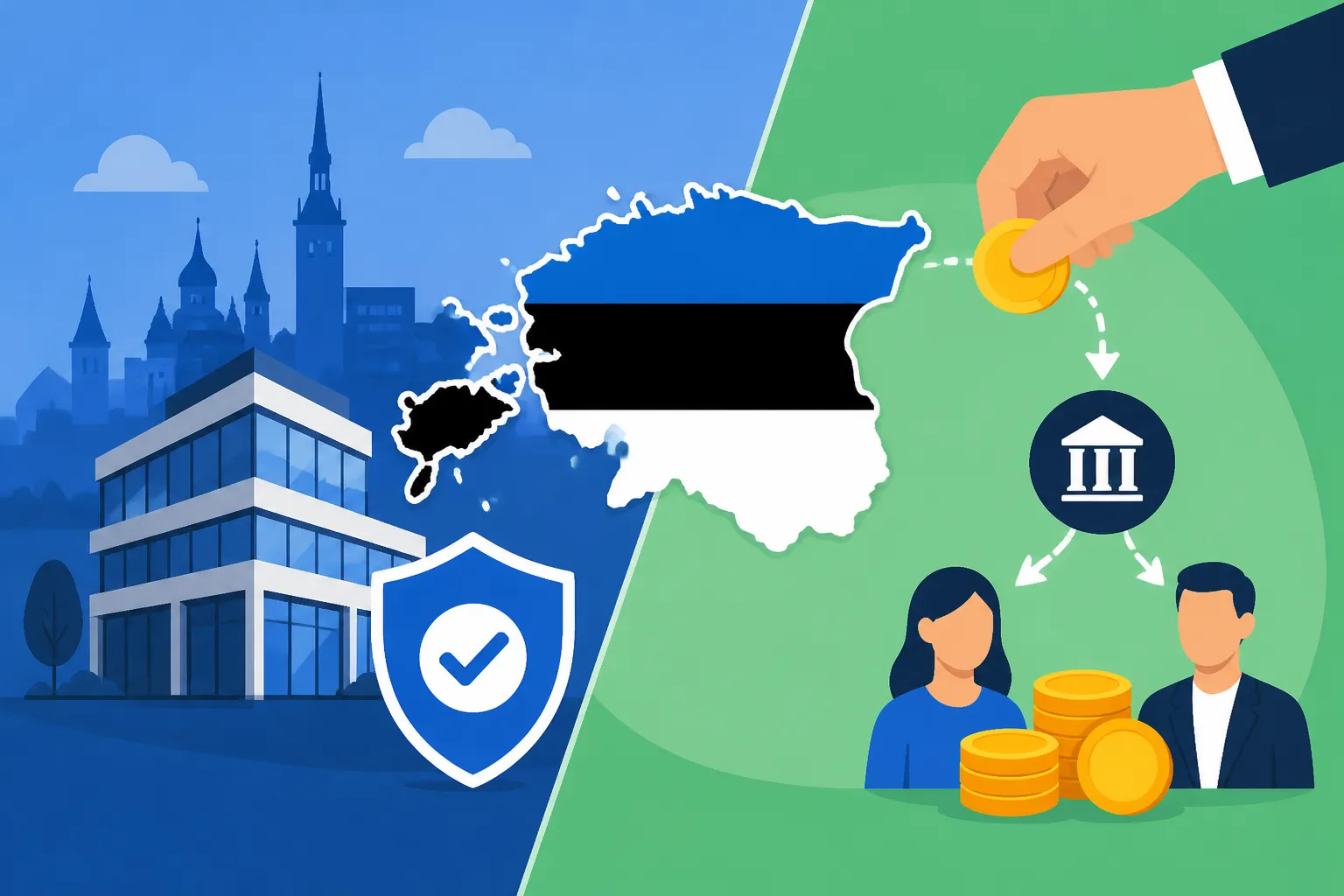
Understanding Why Estonia Taxes Only Distributed Corporate Profit
Oh, the infamous Estonian corporate tax system! When you first hear about it, especially if you’ve spent years slogging through traditional tax codes in other countries, it sounds almost too good to be true, a utopian dream for business owners. "No corporate income tax on retained earnings!" people exclaim. But then, the questions start bubbling up: What does that actually mean? Is it really that simple? Where's the catch? This guide is here to cut through the jargon and the initial confusion, helping you truly understand Estonia’s unique distributed corporate profit tax system and how it impacts expats and businesses here.
The Paradigm Shift: What "Tax on Distributed Profit Only" Really Means
Let's be honest, the concept of a country not taxing corporate profits until they are distributed can feel like a mind-bender if you're coming from a system where companies pay tax on their annual earnings, regardless of whether that money stays in the business or gets paid out to shareholders. Most of us are conditioned to think about corporate tax as a percentage of net profit at the end of the financial year. But Estonia flipped that script entirely back in 2000, and it’s been a game-changer ever since. It's not just a minor tweak; it's a fundamental philosophical difference in how the state views and encourages economic activity.
The Fundamental Difference from Traditional Tax Systems
In many countries, you’ll find that a company calculates its taxable profit, subtracts various allowable expenses, and then pays a corporate income tax (CIT) on whatever profit is left. This often happens annually, a significant chunk of your hard-earned money going to the taxman even before you decide what to do with it. This traditional model means that reinvesting profits back into the company – say, for new equipment, research and development, or expanding operations – is essentially done with after-tax money. It's like you've been paid, taxed, and then you decide to save that money for a big purchase; the tax bite has already happened.
Estonia, however, decided to take a completely different approach. They saw that taxing companies on their profits annually, even if those profits were immediately reinvested, could stifle growth and innovation. Why should a company be penalized for being successful and choosing to put that success back into building an even stronger business? The core idea is simple yet profound: if a company keeps its profits within the business – perhaps to buy new machinery, develop a new product, or expand into new markets – those profits are not taxed. The tax event only occurs when these profits are taken out of the company, usually in the form of dividends to shareholders. This isn't a tax deferral in the typical sense; it's an actual non-taxation of retained earnings.
How This System Works in Practice for Estonian Companies
So, what does this look like day-to-day for a company in Estonia? Imagine your business, let's say a small tech startup in Tallinn. You have a fantastic year, and your profits are soaring. Under a traditional system, you'd be bracing yourself for a hefty tax bill on those profits come tax season. In Estonia, however, if you decide to keep that money within the company – perhaps to hire more developers, invest in a new server infrastructure, or fund your next big marketing push – you pay absolutely no corporate income tax on it. Your profit can be reinvested and grow completely unhindered by immediate taxation. This freedom and flexibility are incredibly powerful.
The tax only kicks in at the moment of distribution. When you, as a shareholder, decide to take a dividend, that’s when the corporate income tax liability arises. The standard rate is 20% on the gross amount of distributed profits, or effectively 20/80 (which is 25%) of the net amount paid out. For instance, if you decide to distribute €80,000 to shareholders, the company needs to pay €20,000 in corporate income tax (20% of €100,000, where €100,000 is the gross profit that includes the tax itself). This means that Estonian companies essentially have a pool of tax-free capital that they can use to fuel their growth as long as they choose to keep it within the business. It’s a powerful incentive for reinvestment and organic expansion, something I've seen firsthand benefit countless startups and SMEs in Estonia.
The Historical Roots: Why Estonia Adopted This Revolutionary Model
When Estonia regained its independence in the early 1990s, it was faced with the monumental task of rebuilding its economy from scratch, transitioning from a Soviet-era command economy to a free-market system. This wasn't just about tweaking existing policies; it was about imagining an entirely new economic framework. The policymakers at the time weren't burdened by decades of entrenched tax structures, allowing them a rare opportunity to innovate and implement truly radical reforms. Their goal was clear: create an environment that would attract investment, foster entrepreneurship, and spur rapid economic growth.
Driving Investment and Economic Growth
The primary motivation behind introducing the distributed profit tax system in 2000 was to stimulate reinvestment of earnings and, by extension, drive economic growth. The logic was elegant in its simplicity: if companies could retain their profits without immediate taxation, they would have more capital available to expand, innovate, and create jobs. This would encourage businesses to keep money circulating within the Estonian economy rather than seeing it siphoned off by annual corporate taxes or, worse, moved to jurisdictions with more favorable tax regimes. It was a bold statement to the world: Estonia is open for business, and we want you to grow here.
This policy has been incredibly effective. Imagine a young Estonian startup that needs to invest heavily in R&D or expand its team. Under a traditional tax system, every euro of profit would first be taxed, leaving less capital for these crucial growth initiatives. In Estonia, that same euro of profit can be fully deployed to fund growth, making the country an attractive hub for innovation, especially in the tech sector. This has been a significant draw for entrepreneurs and investors alike, cementing Estonia's reputation as a dynamic and future-oriented economy. It’s no accident that so many successful tech companies have roots here.
Simplifying Tax Administration and Reducing Bureaucracy
Another significant driver for this unique tax model was the desire to simplify tax administration. Traditional corporate tax systems often involve complex calculations, deductions, and allowances, requiring businesses to spend considerable time and resources on compliance. This can be particularly burdensome for small and medium-sized enterprises (SMEs) and startups, which often lack the extensive accounting departments of larger corporations. The Estonian system drastically cuts down on this complexity.
Under this model, as long as profits are retained, there are no complex corporate income tax calculations to perform annually. Businesses simply need to track their distributions. This not only reduces the administrative burden on companies but also streamlines the work of the Estonian Tax and Customs Board (Maksu- ja Tolliamet). Fewer complex rules mean less room for error, fewer disputes, and a more efficient overall tax system. For expats trying to navigate a new country's bureaucracy, anything that simplifies the administrative load is a godsend. It's often the small, daily frustrations with paperwork that truly wear you down, so having a more straightforward tax system is a welcome relief. This simplification allows business owners to focus on what they do best: running and growing their companies, rather than getting bogged down in endless tax forms and calculations.
Key Advantages for Businesses and the Estonian Economy
The practical benefits of Estonia’s corporate tax system are not just theoretical; they are tangible and have had a profound impact on the country’s economic landscape. For anyone running a business or considering starting one here, understanding these advantages is crucial. This isn't just a quirky tax rule; it's a strategic pillar of Estonia's economic success.
Boosting Cash Flow and Reinvestment Opportunities
One of the most immediate and significant benefits for businesses operating in Estonia is the enhanced cash flow. Think about it: every euro of profit you earn can be immediately reinvested back into your company without first being reduced by corporate income tax. This means more capital is available, sooner, for critical business functions. Need to upgrade your machinery? Launch a new product line? Expand your marketing efforts? You can do it with the full amount of your earnings.
This boosted cash flow means businesses can be more agile and responsive to market changes. They can seize opportunities faster, undertake ambitious projects, and recover more quickly from unexpected challenges. For a startup, this can be the difference between rapid scaling and stagnating due to lack of capital. For established businesses, it means a continuous cycle of reinvestment and innovation. This also reduces the pressure to seek external financing for growth initiatives that could otherwise be funded internally. It empowers businesses to grow organically and sustainably, relying on their own success to fund future success. This freedom can significantly reduce the financial stress that many entrepreneurs face, allowing for clearer strategic thinking.
Attracting Foreign Investment and Talent
Estonia’s unique corporate tax system has become a powerful magnet for foreign direct investment (FDI) and, consequently, a draw for international talent. When investors and entrepreneurs from abroad look at where to establish a new venture or expand an existing one, Estonia's tax environment stands out. The promise of not paying corporate income tax on reinvested profits is incredibly appealing, especially for high-growth sectors like technology, where continuous investment in R&D and scaling is paramount. It signals that Estonia is a place where capital can grow and generate more capital without immediate tax leakage.
This attractive environment isn't just about money; it’s also about attracting human capital. International companies setting up shop here bring skilled jobs, and the overall dynamic economic climate encourages highly qualified expats to consider moving to Estonia. They see a country that supports innovation and entrepreneurship, offering exciting career opportunities and a vibrant business ecosystem. When you're looking to build a career or a business abroad, a country that understands the needs of modern enterprises and actively supports their growth becomes a very attractive proposition. This system has contributed significantly to Estonia's reputation as a digital and business-friendly nation, drawing people and companies from all corners of the globe. Many businesses, including those operating under the banner of Taxes for Expats, highlight this specific benefit to their clients considering an Estonian base.
Navigating the Nuances: What Counts as "Distributed Profit"?
While the "no corporate tax on retained earnings" rule sounds wonderfully simple, the reality is that the Estonian tax authorities have carefully defined what constitutes "distributed profit" to prevent companies from indefinitely holding onto profits while still effectively benefiting shareholders in other ways. It’s not a free-for-all; there are specific triggers that activate the corporate income tax liability, and understanding these is crucial for proper financial planning and compliance. This is where many expats (and even some locals!) can get tripped up, thinking it’s a blanket exemption.
Dividends, Capital Reductions, and Deemed Distributions
The most straightforward form of distributed profit, and thus the most common trigger for corporate income tax, is the payment of dividends. When a company's board decides to pay out profits to its shareholders, that’s when the 20/80 corporate income tax rate applies. This is pretty standard and easy to understand. The company effectively pays tax on the gross amount it allocates for distribution before the net dividend reaches the shareholders. It's a clear-cut transaction.
However, the Estonian system also extends this concept to other scenarios to ensure fairness and prevent avoidance. Capital reductions that result in profit distribution can also trigger the corporate income tax. If a company reduces its share capital and returns funds to shareholders beyond their original contribution, this portion might be treated as a distribution of profit and thus taxed. This is particularly relevant when companies undergo restructuring or decide to return excess capital to owners.
Then there are deemed distributions, which are perhaps the trickiest aspect for many to grasp. These are situations where profits are effectively distributed to shareholders or related parties, even if not explicitly labeled as dividends. This could include, for example, excessive payments made to shareholders for services that are not at arm's length (i.e., not what would be paid to an independent third party). The tax authority aims to catch instances where funds are flowing out of the company to owners or related entities in a way that bypasses the formal dividend payment process but still serves the same purpose of extracting profit. It's a way to ensure that the spirit of the law, which is to tax distributed profits, is upheld. For example, if a company lends money to a shareholder on terms that are clearly not commercial, or writes off a loan to a shareholder, this could be reclassified as a deemed distribution and taxed.
Understanding Fringe Benefits and Their Taxation
Another important area under the umbrella of "distributed profit" is the taxation of fringe benefits ( erastamaks in Estonian). While not directly a distribution of profit to shareholders in the form of cash, fringe benefits are essentially perks or non-cash benefits provided by a company to its employees (including board members and shareholders if they are also employees or managers). These benefits are considered a form of compensation and are taxed at the company level.
Common fringe benefits include things like company cars used for personal purposes, gifts (beyond a certain small value), sports club memberships, private health insurance paid by the company, and even certain housing benefits. The value of these benefits is added to the total amount of distributed profits and subjected to the 20/80 corporate income tax rate, plus social tax and unemployment insurance payments. This can often catch new expat business owners off guard, especially if they are used to more lenient rules for such benefits in their home countries. It's crucial to correctly identify and value all fringe benefits provided by your company to avoid unexpected tax liabilities. For example, if your company provides you with a luxurious apartment that is also used for personal living, the deemed value of that personal use will be subject to corporate income tax and social taxes. This ensures that the tax base isn't eroded by channeling profits through non-cash benefits to avoid taxation.
Implications for Expats and International Businesses
Estonia's corporate tax system doesn't just benefit local entrepreneurs; it has specific and often very favorable implications for expats and international businesses looking to set up shop or expand within the EU. However, it also introduces certain complexities that foreigners, in particular, need to be aware of to fully leverage its advantages and remain compliant. You can't just apply your home country's tax logic here and expect it to work.
Tax Residency and Corporate Structure Considerations
For expats, one of the first things to wrap your head around is the interplay between your personal tax residency and the corporate tax system. While your Estonian company might not pay tax on its retained earnings, you, as an individual, will be subject to personal income tax on any dividends you receive. Estonia has a flat personal income tax rate of 20%, which is levied on the gross dividend payment. So, if your company distributes profit, the company pays the 20/80 CIT, and then you, as a shareholder, pay 20% personal income tax on the net dividend you receive. This means that for individuals who are tax residents of Estonia, the total tax burden on distributed profit can be around 36% (20% corporate, then 20% on the remaining 80%). This might seem high to some, but remember that the company itself has had access to all its profits until that point.
However, the plot thickens for expats who might be tax residents elsewhere. If you own an Estonian company but are a tax resident in another country, you could face different tax obligations. Your home country might tax the dividends you receive from your Estonian company according to its own rules, and you'll need to understand double taxation treaties between Estonia and your country of residence to avoid paying tax twice. This is where professional advice, perhaps from services like Taxes for Expats, becomes invaluable. Understanding your personal tax residency is key, as it dictates where and how your dividend income will ultimately be taxed. Moreover, the choice of corporate structure – whether it's an OÜ (private limited company) or operating as a self-employed individual (FIE) – will also have distinct tax implications. You can learn more about this in our guide on How Much Does It Cost to Register an OÜ in Estonia?.
Accounting and Reporting Requirements for Foreigners
Even though the corporate income tax system is simpler, it doesn't mean you can throw accounting practices out the window. Estonian companies, regardless of ownership, are still required to keep meticulous accounting records and submit annual reports to the Commercial Register. This includes preparing a balance sheet, income statement, cash flow statement, and statement of changes in equity, all compliant with Estonian Generally Accepted Accounting Principles (GAAP) or International Financial Reporting Standards (IFRS) if applicable. For foreigners, this can be a hurdle, as the specifics might differ from what they are used to.
The annual report must be filed electronically, and it needs to clearly distinguish between retained earnings and distributed profits. Failure to comply with these reporting requirements can lead to penalties and complicate future operations. While the tax calculation itself is simpler, the underlying accounting needs to be robust to accurately track profits and distributions. It's also vital to ensure that all transactions are properly documented and that expenses are legitimate business expenses, as any questionable payments could be reclassified as deemed distributions by the tax authorities, triggering unexpected tax liabilities. Many expat business owners find themselves needing to hire local accountants or financial advisors who are well-versed in Estonian specifics to ensure compliance, especially when they are new to the country and its digital-first administrative processes.
Potential Pitfalls and Common Misconceptions
While Estonia's corporate tax system is largely beneficial and a breath of fresh air for many, it's not without its subtleties and potential traps for the unwary. Expats, especially those coming from jurisdictions with vastly different tax cultures, can sometimes fall victim to misconceptions or overlook crucial details that can lead to unexpected tax liabilities. It's not magic; it's a carefully designed system that requires understanding.
The Importance of Proper Financial Planning
A common misconception is that "no corporate income tax" means no tax planning is needed. This couldn't be further from the truth. In fact, due to the trigger-based nature of the tax, strategic financial planning becomes even more critical. Businesses need to carefully consider when and how much profit to distribute, as this directly impacts their tax liability. Indiscriminate distribution without forethought can negate some of the advantages of the system. For instance, if you consistently distribute all your profits every year, your effective corporate tax burden might end up being similar to that in a traditional system, without fully leveraging the reinvestment benefit.
This means actively planning your capital allocation. Are you saving for a large investment next year? Then retain your earnings. Do you need to pay yourself a higher salary or a bonus? Remember that these are business expenses before profit distribution, but if you want to take out dividends, plan for the corporate income tax on that distribution. This kind of planning often requires a shift in mindset from typical annual tax burden reduction to long-term capital growth and strategic cash flow management. It's also important to understand How Does Estonia's Distributed-Profit Corporate Tax Actually Work? beyond just the headline. Engaging with an experienced Estonian accountant or financial advisor early on can save you a lot of headaches and help you optimize your tax position effectively.
Avoiding Unintended Tax Events
Another area where expats often stumble is unintentionally triggering a "deemed distribution" tax event. As mentioned earlier, the Estonian tax authority is vigilant about preventing businesses from circumventing the distribution tax by channeling profits out of the company through non-traditional means. This means that certain transactions that might be considered routine or perfectly acceptable in other countries could be reclassified and taxed in Estonia.
Examples include making interest-free or low-interest loans to shareholders, providing excessive fringe benefits, or engaging in transactions with related parties (e.g., another company owned by the same person) at non-market rates. These are all scrutinized, and if they are determined to be a disguised distribution of profit, the corporate income tax (plus social tax and unemployment insurance for fringe benefits) will be levied. It’s not about finding loopholes; it’s about operating transparently and ensuring that all transactions reflect true business dealings. This is where paying attention to the details of Estonian tax law is crucial. Services like Wise are fantastic for managing international business payments, but you still need to ensure that the underlying transactions are legitimate and correctly accounted for according to Estonian regulations to avoid any nasty surprises. Always err on the side of caution and get expert advice if you're unsure about the tax implications of a particular transaction.
The Broader Economic Impact and Future Outlook
Estonia’s distributed profit tax system isn't just a quirky feature; it's a cornerstone of its economic policy, shaping its development and international standing. Understanding its broader impact helps paint a complete picture for anyone looking to make Estonia their business home. It's a system that has proved its resilience and effectiveness over decades.
Fostering a Startup Nation and Digital Economy
The tax system has played an instrumental role in cultivating Estonia's vibrant startup ecosystem and its reputation as a leading digital nation. By allowing startups to reinvest 100% of their profits back into growth, it creates an unparalleled environment for innovation. Young companies with tight budgets can pour every euro of their initial success into scaling their operations, developing new products, and capturing market share, rather than seeing a significant portion disappear into annual tax payments. This turbocharges their growth phase, often leading to rapid expansion and the creation of valuable intellectual property and jobs.
This has, in turn, attracted more venture capital and tech talent to Estonia, creating a positive feedback loop. The success stories of Estonian unicorns like TransferWise (now Wise), Skype, Bolt, and Pipedrive are, in part, testaments to an environment that actively encourages and enables aggressive reinvestment. For an expat looking to join or start a tech company, the climate here is incredibly supportive, not just culturally but financially. It's a place where your hard work can directly translate into exponential business growth without the immediate tax drag. This unique advantage has been a key reason why many foreign entrepreneurs choose Estonia for their ventures.
Sustaining Fiscal Health and Future Adaptations
Despite the impression that taxing only distributed profits might lead to lower government revenue, Estonia’s fiscal health remains robust. The system encourages more businesses to start and grow, broadening the overall tax base (through social taxes, VAT, and eventually corporate income tax on distributions and personal income tax on dividends). It's a long-game strategy that prioritizes economic activity and growth over immediate tax collection. The government understands that a thriving private sector ultimately generates more wealth for the nation through employment, consumption, and, yes, eventual profit distributions.
As with any tax system, there are ongoing discussions and minor adaptations. The European Union has its own directives and norms, and Estonia, as a member state, must ensure its system remains compliant while retaining its core advantages. For instance, discussions around international tax harmonization and global minimum corporate taxes (like the OECD's Pillar Two initiative) will certainly require Estonia to ensure its unique system aligns with broader international standards without losing its competitive edge. However, the fundamental principle of taxing distributed, rather than retained, profit is deeply ingrained and widely supported. It reflects a core belief in fostering entrepreneurship and investment, a belief that continues to drive Estonia's economic success. For expats, this means a stable and predictable corporate tax environment, which is a huge relief when planning your long-term future here.
Disclaimer
The information provided in this guide is intended for general informational purposes only and does not constitute professional tax, financial, or legal advice. Tax laws and regulations in Estonia, including those related to corporate income tax and profit distribution, can be complex and are subject to change. It is essential to consult with a qualified Estonian tax advisor or legal professional for advice tailored to your specific situation before making any financial or business decisions. The author and publisher are not responsible for any actions taken based on the information presented herein.